
Used Cars & Inspections inspection
What should you check before buying a used car?
The short answer
In order: run the VIN through NHTSA's free recall lookup and a vehicle history report; verify clean title and service records; inspect and test-drive cold, listening for what warms away; then pay an independent mechanic $100 to $300 for a pre-purchase inspection before money moves. Skip steps only if you can afford the repairs you didn't find. A seller who refuses an independent inspection has answered your question.
Assumes: United States market, private-party or dealer used purchases · Inspection prices vary by region and vehicle complexity
Do the paperwork before you drive anywhere
The cheapest checks are the ones you can run from your couch, and they disqualify more cars than any test drive. Pull the VIN from the listing and run NHTSA’s free recall lookup, open recalls are fixed free at any franchised dealer, but you want to know what’s outstanding. Buy a vehicle history report and read it for accident entries, title brands (salvage, flood, lemon buyback), ownership count, and mileage consistency; the FTC’s used-car guidance treats the history report and recall check as baseline diligence, not paranoia. Then ask the seller one high-yield question: “Can I see service records?” A thick folder is worth real money; a shrug is information too.
The looks-and-listens you can do yourself
You’re not a mechanic and don’t need to be, you’re screening for reasons to leave. Panel gaps that vary side to side, paint that doesn’t quite match, or overspray on trim suggest crash repair. Check tire wear across each tire’s width: uneven wear is alignment or suspension talking. Look under the car after it’s sat: fresh spots mean leaks. Inside, every button gets pressed, windows, AC to cold, heat to hot, every seat belt, every light.
Start the engine cold, insist the seller not pre-warm it. Cold start is when weak batteries, rattly startups, and blue smoke confess; a pre-warmed engine at your arrival is a modest red flag by itself.
The test drive that actually tests
Twenty minutes minimum, not a lap of the block. Include highway-speed merging (transmission behavior under real load), a rough patch of road with the radio off (clunks are suspension money), a hard-ish stop in a safe spot (pull or shudder = brake or suspension work), and slow full-lock turns in a parking lot (clicks can be CV joints). Note whether the wheel points straight when the car tracks straight.
The $100 to $300 that saves four figures
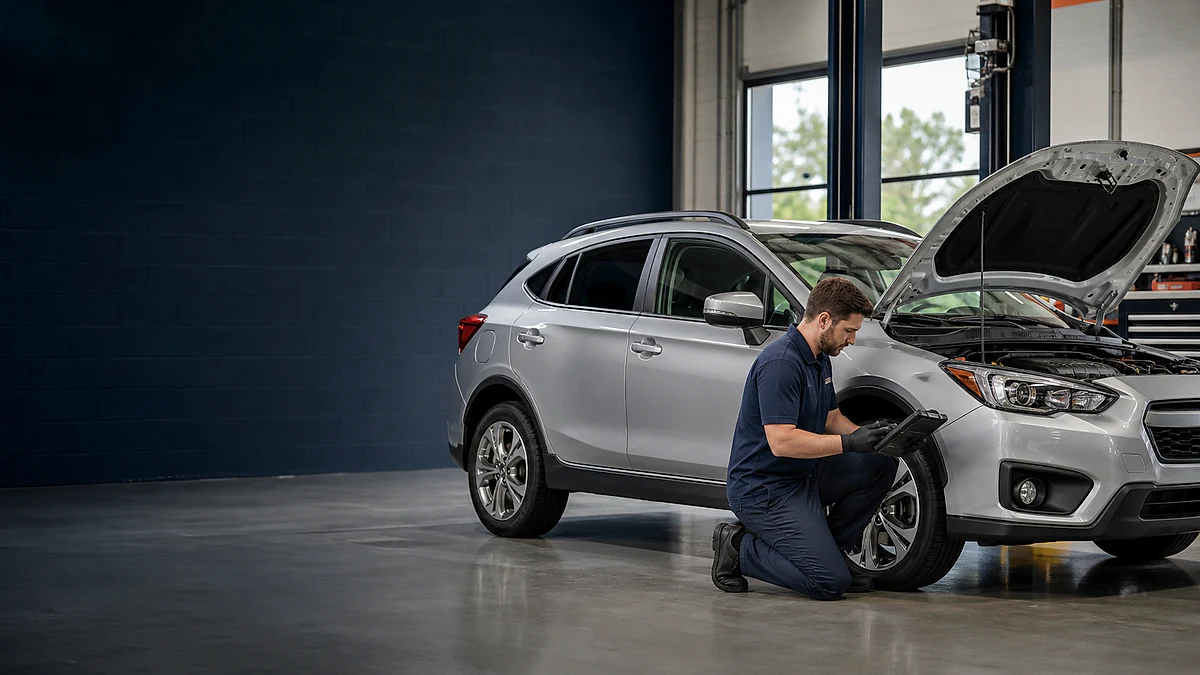
A professional pre-purchase inspection, an independent shop, ideally one that knows the make, and never a shop the seller chose, typically costs about $100 to $300 and covers what you can’t judge: computer diagnostics, frame and structural evidence, brake measurements, fluid condition, and leak sources. That’s roughly 1% of a typical used-car price to convert unknown risk into a written list you can negotiate with. The two honest outcomes: a short list of findings that becomes your price-adjustment sheet, or a refusal by the seller to allow the inspection, which is itself the finding. Walk.
Judgment calls, honestly
Not every flag is fatal. One old fender-bender with documented quality repair on an otherwise solid car can be fine, priced accordingly. High miles with full records regularly beats low miles with none. What shouldn’t be negotiable: structural damage, title brands, evidence of overheating, or a declined inspection. There are always other cars.
Not sure if what you’re seeing is normal? Book a call and let’s talk about your situation.
Next steps
VIN → recall check → history report → records → cold start → real test drive → independent PPI → negotiate on the findings. In that order, with the money staying in your pocket until the last step clears.
Sources
Facts on this page were last verified on .
Independent publication: the author works at Honda of Greenville, but this isn't an official Honda of Greenville or Honda Motor Co. page, and neither reviews, approves, or pays for its content. Content is educational, not mechanical, legal, or financial advice. Verify safety-critical items with a qualified technician and recall status by VIN.